
ABOUT CARBONLESS
Home of the Super Energy-Efficient & Healthy Home (and Building).
Every One. Built to Last 100 to 250 Years.
This is the standard Carbonless teaches.
THE LAND NOBODY KNOWS I PLANNED
I developed about 3,000 residential lots. About 2,000 of them were for affordable housing. I drew every one of those developments on paper before a road went in. I built about 24 miles of road, worked through about 50 stormwater permits without a reported violation, and moved about 10,000 trees.
Thousands of families live on that land today. Most of them have never heard my name, and they shouldn’t have to. But the decisions I made about the water, the soil, the trees and the roads are still with them every day. That’s what I mean by the footprint we leave behind.
Fifty-two years
I started in construction at 14. In 1979 I became a Minnesota Certified Energy Auditor, the same year I figured out why a house we had fixed three times kept growing mold in the corners. I designed more than 750 homes and remodeled about 300 more. I sold real estate for 36 years and sat across the closing table from more than 3,000 families. That’s where I learned the price of a house is only the start. The bills, the repairs and the dampness decide whether a family gets to stay. Along the way I owned businesses, raised investment capital, managed people, developed property and sold real estate. I’ve spent my whole life finding problems, inventing answers and living with the consequences when things went wrong.
The hard years
I had residential and commercial real estate and my broker’s license, and I thought that would protect me when the market turned. It didn’t. When the bank called the loans, I found out I was the only partner who had signed a personal guarantee. I lost a great deal. In my account of it, what the bank did to me was fraud.
Then, in 2010, that same bank hired me to oversee selling the properties it had foreclosed on, because it needed my broker’s license. The bank did the foreclosing. I managed the disposition of about 3,000 foreclosed properties: houses, commercial buildings, land and whole developments. I directed 17 real estate companies, and together we sold about 1,000 of those properties in 26 months. We still couldn’t save the bank. I learned more about risk, money, debt and long-term ownership in those years than in all the rest of my career put together. That is a big part of why Carbonless looks at what a building costs a family for the next hundred years, not just what it costs to buy.
The inventions
I invented the Thermal Stud (Tstud), WarmStud, DrainStrip, TSUPS and other building products, and raised money from about 200 shareholders who believed in bringing them to market. I owe those investors a great deal. Students at North Iowa Area Community College built a WarmStud house. The patents name me as the inventor. They are owned by a separate company now, and I don’t own any part of them.
U.S. patents: 9,677,264 (2017), thermal-break wood stud and wall framing system · 9,783,985 (2017), thermal-break stud with non-metal fasteners · 10,731,332 (2020), composite reinforced wood stud · 11,255,084 (2022), thermal-break wood columns, buttresses and headers · 12,448,780 (2025), moisture-porous building furring strip · Design patents D936,242, D938,618, D941,496, D941,498 and D942,049 (2021–2022) and D1,033,679 (2024), reinforced wood studs.
Canadian patents: CA 2,991,743 (2021), thermal-break wood stud and wall framing system · CA 3,083,121 (2023), thermal-break wood columns, buttresses and headers. Other patent applications and international filings are still being reconciled and aren’t counted here.
I got tired of filing patents and then fighting to keep them, so I put about 20 more ideas, roughly 200 potential claims, into my novel Hammerdahl instead. I also made mistakes that cost me millions. I can’t get that money back, but I can help you skip them.
The house I live in
So I built a house to prove it. A two-story, three-bedroom, two-bath house from a Habitat for Humanity plan, built for about $132 a square foot. My whole utility bill is about $60 a month. That’s heating, cooling and everything else. Your house will be different, but it shows what getting the walls, the roof, the air and the moisture right can do.
Bigger than me
Carbonless is a nonprofit now, and it’s bigger than one man. Twenty founding members bring an estimated 10,000 projects of their own. They’re builders, testers, insurers, and restoration and heating-and-cooling professionals in the U.S., Canada and the UK. In 2026 about 180,000 people started following along, and our videos have been watched about 90 million times without a dollar spent on ads. The studying is done. The knowledge exists. The experience exists. Now we put it to work, with the most affordable materials people can get wherever they live.
— Brian Iverson, Founder & President, Carbonless, Inc.
THE MISSION
Carbonless teaches people how to make a house or building super energy-efficient and healthy, so it lasts 100 to 250 years.
I never know who is going to reach out next. It might be a roof, a retrofit, mold, mildew or rot. It might be someone whose last two new houses ended up with mold, and now they want to build one where mold has no place to grow. So I teach all of it: how to fix the house or building you already have, and how to build a new one right from the start.
It does not matter if it is a small house, a big custom home, a barndominium, a shop or the building where you work. The same rules about heat, air and water apply to all of them.
I teach. I don’t build.
Carbonless is a nonprofit. I do not build, and I do not sell anyone’s products. You and your builder do the work. My job is to help you understand it, so you can make your own decisions.
I want the same thing for your family that I want for my own children and grandchildren: a home that costs less to live in, is healthy to breathe in, and can be passed down. And when it is sold someday, the next family should get a house built with care, not hidden problems.
I teach it the way I would across the kitchen table. First I show you how the problem happened. Then I show you the better way.
Affordable Housing matters. Affordable Living matters more.
What it looks like in practice: cut the utility bill in half. Or better.
A house built to the Carbonless Standard costs its family roughly half what that same house costs to run when it is built to the prevailing minimum code across most of the United States and Canada. It does that on the envelope alone — before any solar, any on-site generation, any added technology. Not for a year. For as long as the building stands.
One honest word about that number, because it matters. Codes are not the same everywhere. A few jurisdictions have adopted far more demanding energy codes than the rest, and a house built to one of those already starts closer to where we are headed — the gap there is smaller, and we will say so plainly rather than pretend otherwise. The comparison above is against the minimum most of this continent is actually building to today.
AND IT’S NOT A RETURN ON INVESTMENT. IT IS A RETURN ON EFFICIENCY™
An investment pays back once and then it is finished. Efficiency built into an envelope pays back every month, to every family, for the entire life of the building. The first owner gets it. So does the fifteenth. So does the twenty-fifth. That is the difference between a payback period and a legacy — and it is why generational housing is not a trend that will pass. It is the right way to build something that has to stand for a hundred years.
Here is why it has to happen now.
Over the long run, the utility bill keeps going up. A family paying three hundred dollars a month today will pay a multiple of that before the mortgage is retired, and the family living there after them will pay a multiple of that again. Every house we put up to the minimum a code allows locks that in — for a hundred years, for every family who ever comes through the door.
We are about to build the next fifty years of housing. If we build it the way we built the last fifty, we will have handed every generation after us a bill they cannot control and never agreed to. That decision gets made now, in 2026, or it does not get made at all — because you cannot go back and re-decide a house after it is standing.
And it has to be affordable to build, or it never gets built.
That is the part almost everybody misses. A house nobody can afford to construct protects nobody. So this is written for what a builder can actually deliver, on a real budget, in a real market — the most efficient structure that can honestly be built for what people can honestly pay. A beautiful theory nobody builds is worth nothing to a family.
HERE IS WHAT WE CANNOT PROMISE.
We would guarantee all of it if we could. We cannot, and we will not pretend to.
We do not control how many people live in a house, or what they plug in, or how many aging cats and dogs share the place, or whether somebody throws the windows open on a hot, humid August afternoon and invites every bit of that moisture inside. That is the family’s house and the family’s business. And occupancy does not hold still — the household in year one is not the household in year fifty. A house that served two people can end up serving seven, and the building has to be honest for both.
Carbonless is an educational organization. We teach. We do not design, engineer, build, or certify anyone’s building, and we do not represent products or manufacturers. What we can do is make the building itself as good as it can honestly be made — so that whoever ends up living there, first owner or fifteenth, starts from the best position anyone could have handed them.
WHAT CARBONLESS IS
Carbonless is an educational organization.
We teach how buildings actually work — the whole building, from the ground it sits on to the family that will live in it a hundred years from now.
Not one trade. Not one product. Not one part of it. The whole thing.
We are a Minnesota nonprofit, recognized under Section 501(c)(3). We do not design, engineer, build, or certify buildings, and we do not sell anyone else’s. We teach, we document, and we hand what we learn forward.
WHY IT MATTERS
A building does not have to fall down to fail.
Most of them fail quietly. On the utility bill, month after month, for a hundred years. On the air the family breathes. On the wall that gets opened in year twenty and found rotten. And the people living inside almost never learn that what they are paying for was decided long before the first stud went up — by somebody they never met, in a meeting they were never invited to.
Sixteen different people decide the fate of a house. The developer who picks the land and reads its water. The engineer who decides where that water goes. The architect who points the house at the sun or at the street. The lender who prices the loan but never the operating cost. The builder who has to make all sixteen decisions meet inside the same wall. The inspector who signs it off against a code that is the least the law allows, not the most a family deserves. And the owner and the occupant, who pay for every one of those choices for as long as they live there.
Not one of those people is doing anything wrong. Every one of them is doing exactly the job they were trained to do, in the room they were assigned.
The failure is the wall between the rooms.
That is what Carbonless exists to take down.
WHAT WE REPRESENT
We represent the owner, the occupant, and the tenant — the people who pay the bills, breathe the air, and inherit every decision made before they arrived.
And we represent systems, not products.
There are thousands of good building products in the world, and not one of them can create a healthy, durable, super energy-efficient building by itself. A wall has to work with the roof. The roof has to work with the foundation. The insulation has to work with the air barrier. The windows and doors have to work with the enclosure. And the whole enclosure has to be designed at the same time as the heating, cooling, ventilation, filtration, and humidity control — not after.
And it all has to be designed at the same time. The heating, the cooling, the ventilation, the filtration, the moisture control — drawn while the house is being drawn, not called in afterward to solve a problem the drawing already created. That is how every one of those systems ends up inside the envelope, where it belongs, instead of hung out in an attic that hits a hundred and forty degrees in July and asked to cool the house from there.
You cannot do this in sequence. You cannot finish the house and then phone the mechanical designer. There is no version of this that works one piece at a time.
Everything has to work together, or it does not work at all.
So Carbonless studies how products actually behave together and puts them into complete systems that builders, owners, and communities can understand and use. We are not here to promote a manufacturer. We are here to represent the family who will still be living with that building in a hundred years.
A few things we believe, and do not intend to stop believing:
Reduce the demand before you add the technology. Measure performance instead of assuming it. Build for the honest extremes of the actual place, not the minimum a code assigns to a ZIP code. Write it down, so the next person does not have to learn it the hard way. And leave every generation something better than the one before it.

THE LONGER VIEW
Affordable housing matters. Affordable living matters more.
The bill is where it starts, not where it ends. Carbonless exists to advance sustainable building by making practical, whole-building knowledge available to the world — so the buildings we leave behind are healthier to occupy, more affordable to operate, more durable, more efficient, more resilient, and genuinely capable of serving the next twenty-five owners.
We are not waiting for codes to solve it. We are not waiting for the industry to agree.
We are listening, documenting, testing, teaching, and moving forward.
Because the next 250 years begin with one person willing to build differently.
WE HAVE BEEN LISTENING
Since January 2026, Carbonless has reached more people than I ever imagined possible. Our videos have received about 90 million views across Instagram and Facebook, without spending a dollar on ads. Since Memorial Day, more than 80,000 additional people have chosen to follow the mission. And during 2026 alone, I have personally responded to roughly 72,000 comments and messages — which does not count the emails, the texts, the phone calls, or the conversations that happen every day.
That number is almost hard for me to comprehend. But every one of those conversations mattered.
God gave me two ears and one mouth, and I have tried to use them in that proportion.
I have listened to homeowners tired of utility bills they cannot control. To builders who want to do better work and were never taught how each part of a building changes the next. To architects, engineers, developers, REALTORS®, lenders, attorneys, manufacturers, building officials, remodelers, inspectors, and the people who actually live in these buildings.
They want healthier homes, cleaner indoor air, lower energy use, affordable living, stronger communities, and buildings capable of serving families for generations.
Those conversations changed how we are delivering this mission.
WE ARE NOT REBRANDING
The mission has not changed. What changed is the number of people asking for help — and the responsibility that comes with it.
There is no way for me to answer every building question one conversation at a time. Not at three hundred a day. So instead of trying, we are preserving the knowledge: organizing fifty-two years of field experience into field guides, assembly references, educational materials, and Carbonless 2126 — so it outlasts me, and outlasts anyone’s inbox.
THE NEXT CHAPTER
Carbonless is building a complete pathway for anyone who wants to understand or create a better building.
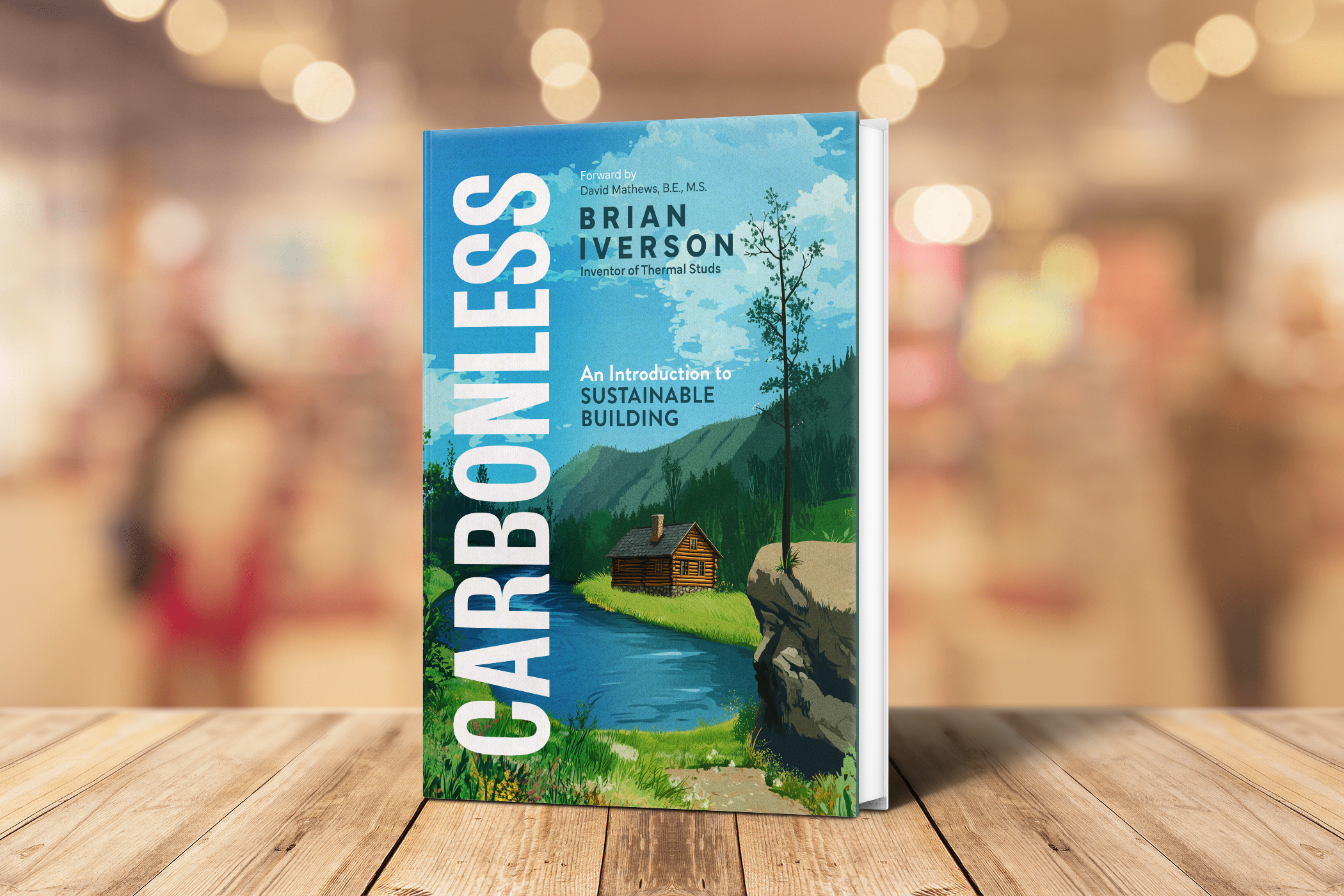
The Super Energy-Efficient & Healthy Home Field Guide memorializes how Brian built his own home — the Beaver Den, known in the family as the Dad Pad. More than 150 construction photographs, field observations, sequencing, the products used, effective R-values and U-values, and the practical methods worked out over five decades in the field.
The Field Guide does not teach the reasoning behind every decision, and it does not correlate the assemblies to a load calculation. That belongs inside Carbonless 2126.
The Wall and Roof Assembly Library provides practical construction options, including the Hot Roof Failure Guide.
Carbonless 2126 teaches the complete methodology behind all of it — from pre-development and land evaluation through design, construction, mechanical sizing, occupancy, maintenance, remodeling, and the twenty-fifth occupant.
The Field Guides show what was built. Carbonless 2126 teaches why.
It brings together the perspectives of the sixteen responsible parties affected by every building, and the forty courses that have to work together before a building is whole.
Carbonless 2126 puts the whole building process in one place. It comes from a lifetime spent in nearly every seat at the table, and from understanding that a building cannot be designed apart from the land, the financing, the construction, the mechanical systems, or the families who will live in it.
By the numbers:
90 Million+
About 90 Million Views in 2026 Across All Social Media
180,000+
Total Followers and Growing
300+
Remodeling Projects
8 Climate Zones
Work Spanning All 8 North American Climate Zones
72,000+
Comments & Messages Personally Answered in 2026
80,000+
New Followers since Memorial Day
~3,000
Acres Developed
52 Years
Construction Experience Distilled Into Our Education Material

Brian Iverson
Founder
Journeyman carpenter. Four years full time in drywall finishing. Vocational-technical training in architecture and civil engineering. Former Minnesota Certified Energy Auditor. Land developer, remodeler, REALTOR®, and building-envelope specialist, with decades of work in real estate, development, foreclosure, conservation, product invention, and whole-building performance.
Inventor of:
The Tstud™ Technology. Eleven issued U.S. patents and two confirmed Canadian patents name Brian as inventor (listed above). The patents are owned by a separate company.
WarmStud™
Thermal Studs Ultimate Panel System™ (TSUPS™)
Additional patented and patent-pending building technologies
ONE LAST THING
None of this started in a classroom. It started with a 14-year-old kid on a job site.
I was hanging sheetrock at 15. In high school I went to class in the mornings and worked eight hours every afternoon. Half of everything I made, from trapping muskrats to my paper route, went to my parents.
I watched my parents struggle through the oil crisis. My dad sold his truck that got 8 miles to the gallon and bought a Pinto, just so he could afford to drive 35 miles to work. In 1979 I became a Minnesota Certified Energy Auditor, and I made up my mind that families should not have to live like that.
I have been in construction since 1974, 52 years now. Since then I have designed more than 750 buildings that got built and remodeled more than 300. I developed about 3,000 acres into more than 3,000 lots, built 24 miles of road, and pulled 50 stormwater permits without one violation. I closed more than 3,000 real estate transactions and filed 19 patents for energy-efficient products. I have walked through about 25,000 jobs. I made mistakes along the way, and some of them cost me millions. I wrote them down so you don’t have to make them.
Every project I touch has the same goal: cut the utility bill in half, and leave a house that is healthy and still standing strong 100 years from now.
But Carbonless is bigger than me now. Members from the United States, Canada and the United Kingdom sit at the same table, and every one of them brings their own story.
Welcome to Carbonless.