
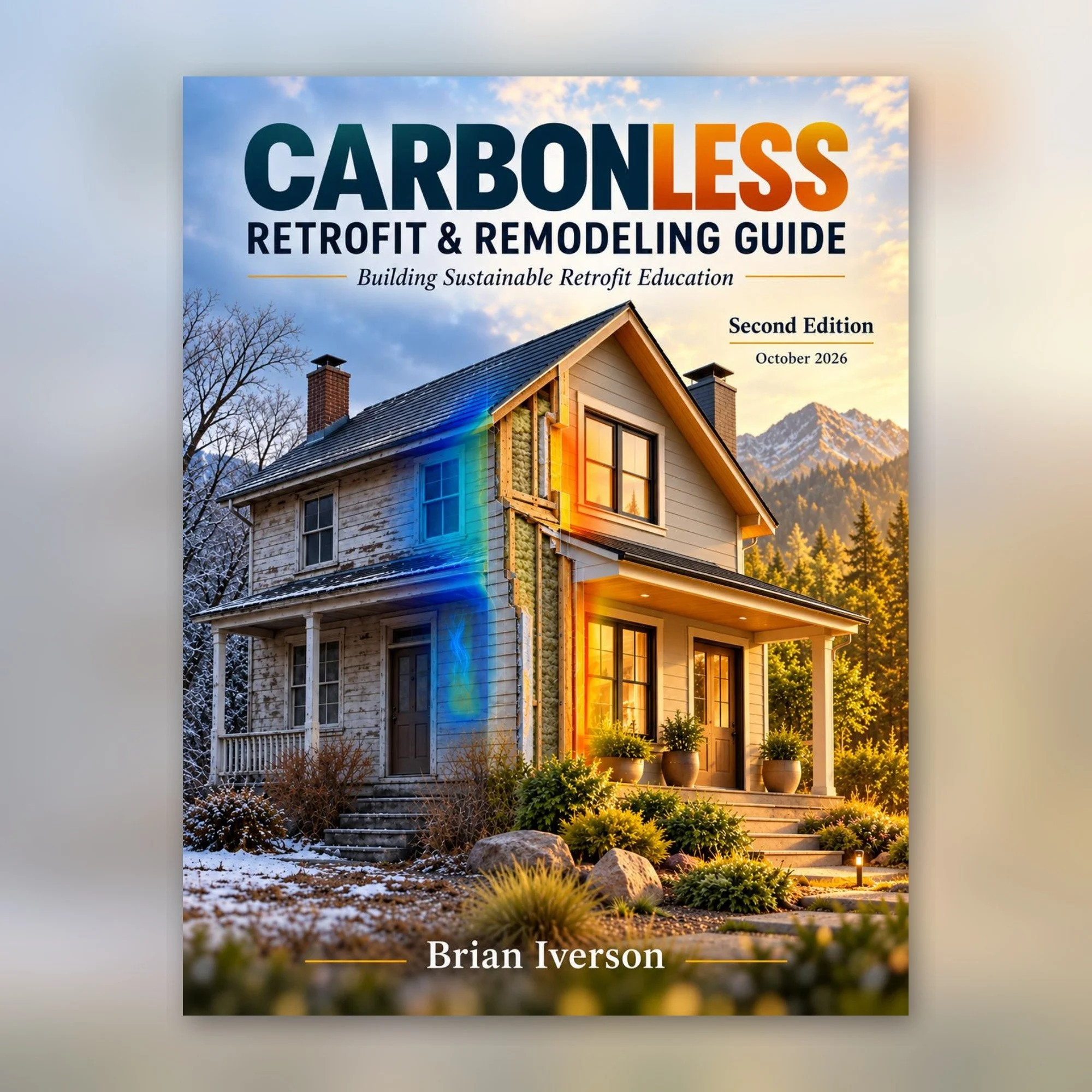
This guide is for people working on real houses. Not perfect ones. Not new ones. Not houses on paper.
Every action has a reaction, and retrofit is where that gets people into trouble. You add insulation, and another surface gets colder. You seal air leaks, and moisture loses its escape route. None of those are bad decisions, but none of them are neutral.
Written by Brian Iverson, with 52 years of field experience, this guide explains how heat, air, and moisture actually move through an existing house, why mold shows up in normal houses, and how to put a wall, rim joist, ceiling, or roof back together so it can dry, tolerate mistakes, and last.
The second edition has nine chapters and two real case studies with field photos and thermal images, including a 1908 Craftsman with an $800-a-month utility bill. It's for builders, remodelers, homeowners, inspectors, mold remediation professionals, architects, and anyone who has to decide what to do before a wall gets closed.
This is educational. It's about cause and effect, not a one-size-fits-all recipe.
Instant PDF download. Searchable, with clickable chapter navigation.
Your utility bill is not going back down.
Learn the Why. Understand the Fix. Build Back Carbonless.
Rising utility costs are not going away. The best time to improve an existing home is when you already have it opened up for a remodel, repair, or renovation.
Carbonless gives you three levels of retrofit education. Start with the amount of help you need.
Three Levels of Retrofit Education
Fix What the Envelope Got Wrong — $49
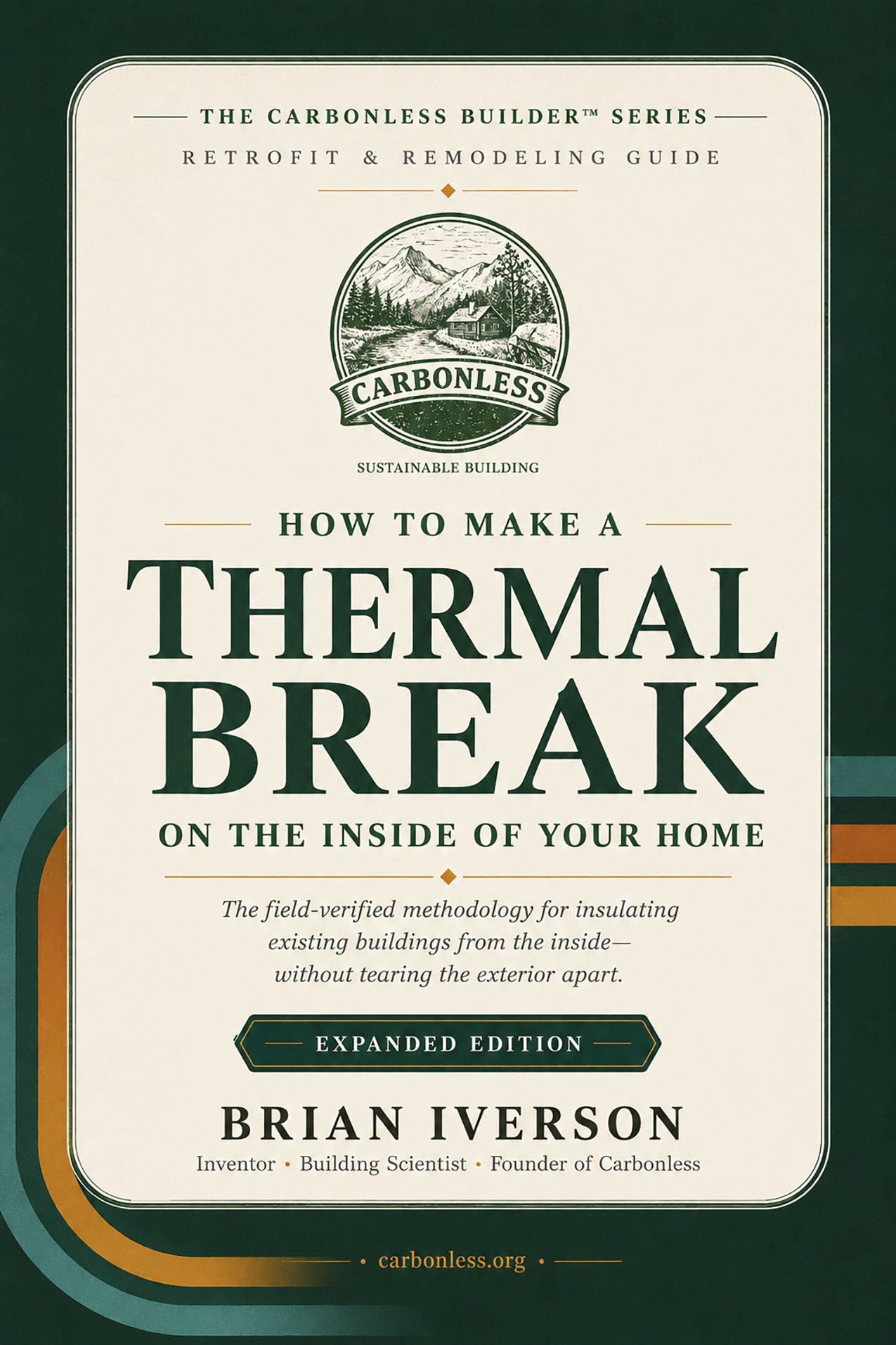
Start here. Learn what may have been missed when your house was originally built, how heat, air, and moisture move through an existing home, and what you need to understand before you start tearing things apart. Think of this as your homework before the remodel begins.How to Make a Thermal Break on the Inside of Your Home — $199
Go deeper into the actual method. Learn how to improve the thermal envelope from the interior when the outside of the home cannot reasonably be changed. This guide covers thermal breaks, assemblies, insulation, installation strategies, construction details, and the thinking behind the Carbonless approach.The Carbonless Builder Retrofit & Remodel Field Guide — $449
This is the full walk-through. Follow the retrofit and remodeling process from investigation through rebuilding, with photographs, field examples, decision points, moisture and thermal considerations, and the questions that need to be answered before the walls get closed again. It is designed to help you understand what to look for, what to ask, and what happens next.
Start with the knowledge. Make better decisions. Reduce the load. Protect yourself from rising utility costs. Build Back Carbonless.
Three Guides. Three levels of Mastery.
If you’re just learning about the concepts, start with the starter guide. If you need to build a hot roof or are looking to retrofit-remodel your existing structure and want a thermal break inside of your house, the Thermal Break Guide is for you. If you’re ready get the full process from start-to-finish with visual examples and references - whether you’re communicating the concepts to your builder, or you’re retrofitting the structure yourself - get the Field Guide.
Get Started with the Introductory eBook
This guide is for people working on real houses. Not perfect ones. Not new ones. Not houses on paper.
Every action has a reaction, and retrofit is where that gets people into trouble. You add insulation, and another surface gets colder. You seal air leaks, and moisture loses its escape route. None of those are bad decisions, but none of them are neutral.
Written by Brian Iverson, with 52 years of field experience, this guide explains how heat, air, and moisture actually move through an existing house, why mold shows up in normal houses, and how to put a wall, rim joist, ceiling, or roof back together so it can dry, tolerate mistakes, and last.
The second edition has nine chapters and two real case studies with field photos and thermal images, including a 1908 Craftsman with an $800-a-month utility bill. It's for builders, remodelers, homeowners, inspectors, mold remediation professionals, architects, and anyone who has to decide what to do before a wall gets closed.
This is educational. It's about cause and effect, not a one-size-fits-all recipe.
Instant PDF download. Searchable, with clickable chapter navigation.
Ready to Make Your House Carbonless®?
Your utility bill is not going back down.
In the last five years the price of residential electricity in America climbed about 21 percent. In 2025 it rose faster than inflation — faster than groceries, faster than gas, faster than medicine. One in six households is already behind on their energy bills. Hundreds of utilities have rate increases approved or pending through 2027. Nobody is forecasting relief.
Now run that forward thirty years.
The house you own — or the one your kids hope to own someday — is going to cost more to heat and cool every year for the rest of its life. Not because of how you live in it. Because of how it was built. A building built to code is built to the floor — the legal minimum — and then the family inside it pays the difference between the floor and what the building should have been, every single month, forever.
That is the math nobody wants to look at. A whole generation priced out of affording the buildings they already live in. Kids who cannot afford the land to build on because the utility bill on the house eats the down payment.
Here is the part nobody is telling you: you can break that curve from the inside.
You do not have to tear the house apart. You do not have to rebuild the exterior. A thermal break on the inside of your existing walls can cut what that building costs to operate — permanently, for the rest of its life. This eBook is the only place that method is written down in plain language.
That is why this exists. Not to add a book to a shelf. To put the way out in the hands of the people who need it, before the thirty-year bill comes due.
[Source note for Rob, not for the page: the 21% / faster-than-inflation / 1-in-6 figures are verified from EIA and Center for American Progress data, May 2026. Safe to publish. Do NOT add a specific dollar forecast for 30 years out — state the trajectory, not a made-up number.]
Here is what almost nobody understands about an existing wall.
At just a half-inch of interior strip depth — the thinnest application there is — a typical wall gets a continuous thermal break from the inside. Even with one of the most affordable fills there is, blown-in cellulose, that half inch lifts the whole-wall effectiveness by more than 25 percent over the bare existing wall.
A half inch. The most affordable fill. Over 25 percent better.
Now imagine what the best assemblies in this eBook do at two inches — over 138 percent more efficient than the wall you have today. Picture that number dropping into a Manual J load calculation: a smaller heating and cooling load, smaller equipment, a lower utility bill every month for the life of the building.
Most people have never heard of a Manual J. That is exactly the problem. This eBook shows you the number, what it means, and how to use it — for every common wall assembly, at every strip thickness, with the verified math behind it.
Product Description
In the last ten days alone I took twenty consulting calls. This eBook answers almost all twenty.
Over the years I have taken somewhere between one and two thousand of those calls. Different buildings, different climates, different families — but the same problems came up again and again. This eBook is that common core: the diagnoses and the answers most callers needed, written down once so you do not have to pay for the call to get them. It is not every consult I have ever done — no eBook could be, and a truly one-of-a-kind building will still need a set of eyes on it. But the part almost everyone needs is here, and for most buildings it is enough.
Fifty-one years of field work produced this. Twenty-five thousand homes walked. Two thousand real estate closings. Every principle came from a building that failed, every rule from a consequence, every number measured or calculated in a real assembly in a real building lived in by a real family.
Lessons learned. Now lessons taught.
What This Is
Nobody teaches how to make a thermal break from the inside of an existing building. It is not in the code. It is not verified by inspectors. It is not specified by most architects. And in many existing buildings it is the only thermal break available — because you cannot tear the exterior apart to add it from the outside.
This eBook is the only place that methodology — the strip method, the full installation sequence, the climate-zone guidance, the dew-point framework, and the verified assembly tables — is written out in plain language for anyone who lives in, works in, owns, manages, or builds a structure.
What's Inside
Thirty chapters across 279 pages. The diagnostic framework for reading any building. How heat, air, and moisture actually move. Why mold appears and what it is really telling you. The interior thermal break strip method, step by step. The ceiling assembly that takes an attic from R-25 to R-70. Closed cell spray foam done right. Windows, vapor, ventilation, and stopping moisture at the source. What your 2×4 and 2×6 walls actually perform at, with the numbers. Manual J. And the complete retrofit business blueprint for the contractor who wants to build a premium service around verified performance.
A full performance-path appendix — every common cavity insulation type, 2×4 and 2×6, with verified R-value, U-factor, and percentage improvement at every strip thickness, plus the hot roof panel assembly.
NOW INCLUDES THE NEW GUIDE: Why Roofs Fail — And How They Win
This Is Also a Business Plan
The contractor who reads this completely has everything needed to build a retrofit service that delivers measurable, documented, verifiable improvement — the diagnostic as a paid service, the scope of work, the pricing, the client communication, and the documentation that turns a retrofit into a marketable asset for the owner.
A Global Fix
The physics is the same in every language. The assembly tables include metric values for Canada and translate across climate zones worldwide. The thermal bridge conducts heat at the same rate in Minnesota and Manitoba and Munich.
Who It's For
The homeowner who found mold at midnight. The woman who has been right about her house for three years and nobody listened. The remodeling contractor who wants a premium business. The architect who wants assemblies that perform. The property manager whose portfolio bleeds energy. Anyone paying a utility bill they should not have to pay.
Delivered as a downloadable eBook (PDF). Read it at midnight, act on it in the morning.
The Heartfelt WHY
I have been consulting my life away. Every day the phone rings. Every day somebody needs an answer. And every day that knowledge helped one family, solved one problem, and then the next call came.
I want to take my grandkids fishing rather than repeating the same thing in every consulting call. That is not to say I don’t enjoy helping people directly... I have knowledge that does not exist anywhere else in the form I carry it — not in any university program, not in any code book, not in any manufacturer's guide. If I do not write it down, it goes with me, and the families who need it do not get it. That is not acceptable to me.
So I wrote it all out. Because the family paying $400 a month in a house built to code deserves to know why. Because the woman who has been right about her house for three years deserves to understand what she has been smelling and feeling. Because our kids and grandkids cannot afford the land to build on if they spend everything they earn on utility bills in buildings that were built to the floor and called done.
Build it better. Afford to live in it. Leave it better than you found it. That is the whole thing.
The Thermal Break eBook Bundle NOW INCLUDES THE NEW GUIDE - ABSOLUTELY FREE!
Why Roofs Fail — And How They Win (Hot Roofs, Cold Roofs & Lung System)
Go the Distance with the Field Guide
Got it. No more em dashes in your website copy. I'll keep the writing plain, natural, and like you talk.
Here is the cleaned version:
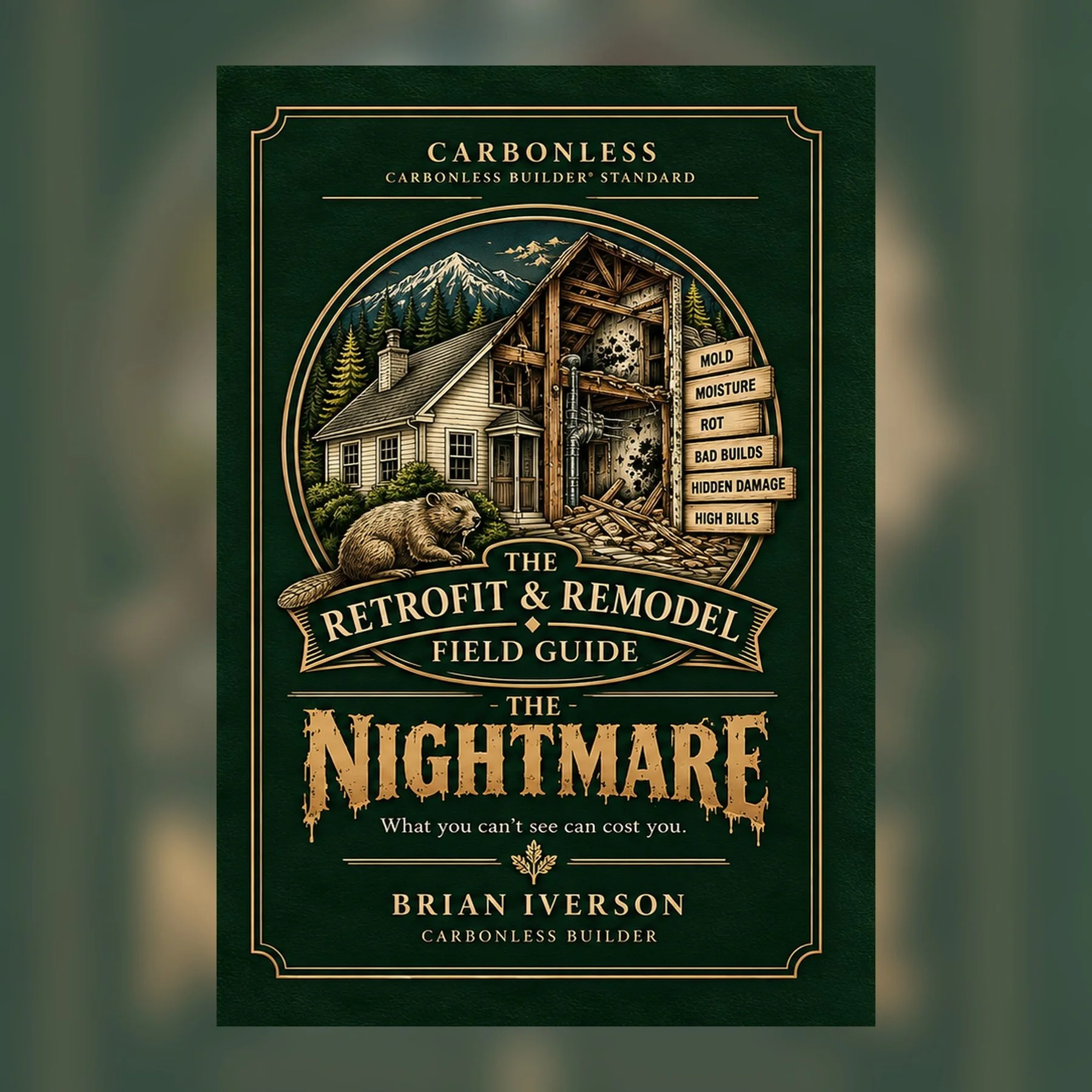
THE RETROFIT & REMODEL FIELD GUIDE: THE NIGHTMARE
DIGITAL EDITION | INSTANT DOWNLOAD
This listing is for the digital edition. No physical book will be shipped with this purchase.
Real Buildings. Real Failures. Real Solutions.
The Carbonless Retrofit & Remodel Field Guide is built from more than 25 real projects and consulting jobs from the last two years.
Nearly 200 field photographs take you inside existing homes and buildings to see what actually went wrong and what can be done differently.
This isn't a book filled with pretty finished rooms.
It's what you find when you open the building up.
Mold. Mildew. Rot. Water intrusion. Failed walls. Window problems. Air leaks. Moisture problems. Thermal bridges. Mechanical issues. Multiple hot-roof failures.
See the Problem Before You Try to Fix It.
Every photograph has a purpose.
The descriptions explain what you're looking at, why it happened, what building science principles are involved, and what should be considered before the building gets put back together.
You'll see examples from:
• More than 25 real projects and consulting jobs
• Nearly 200 field photographs with detailed descriptions
• Mold, mildew, and rot investigations
• Multiple hot-roof failures
• Exterior wall problems
• Window and opening failures
• Water and moisture intrusion
• Air leakage and thermal bridging
• Insulation and control layer problems
• Remodeling transitions between old and new construction
• Existing conditions that weren't discovered until the building was opened
• Repairs, corrections, and lessons learned in the field
Remodeling Is Your Second Chance.
New construction gives you one opportunity to get it right.
A remodel gives an existing building another opportunity.
Once the walls, roof, floors, windows, or other assemblies are opened, you have a chance to understand what failed and rebuild them to perform better.
The goal isn't simply to make an old building look new.
The goal is to make it more energy efficient, healthier, more comfortable, and more durable than it was before.
You Don't Have to Be a Building Scientist.
Brian Iverson has spent more than 50 years in construction, remodeling, design, energy auditing, development, real estate, and building performance.
This guide takes that experience, plus evidence from more than 25 recent real-world projects, and puts it into a visual format people can actually follow.
Homeowners. Remodelers. Builders. Architects. Drafts people. Inspectors. Mold remediation professionals. Tradespeople. Building performance professionals.
If you work on existing buildings, this guide was built for you.
Follow the pictures. Read the descriptions. Understand what failed. Learn why it failed. Then make a better decision before you close the building back up.
DIGITAL EDITION | $349
Instant digital download. No physical book will be shipped with this purchase.
Prefer a real book you can hold, mark up, and take to the jobsite? The hardcover edition is available separately below.
Find the cause. Understand the building. Put it back together better.
What you can't see can cost you.
This guide is educational material. It is not architectural plans, engineered drawings, code approval, or project-specific professional advice. Every building must be evaluated for its own existing conditions, site, climate, adopted codes, and requirements by appropriately qualified professionals.
Nearly 200 photographs. 25+ real projects. Nothing staged. Nothing hidden. Just real buildings teaching us how to build better.
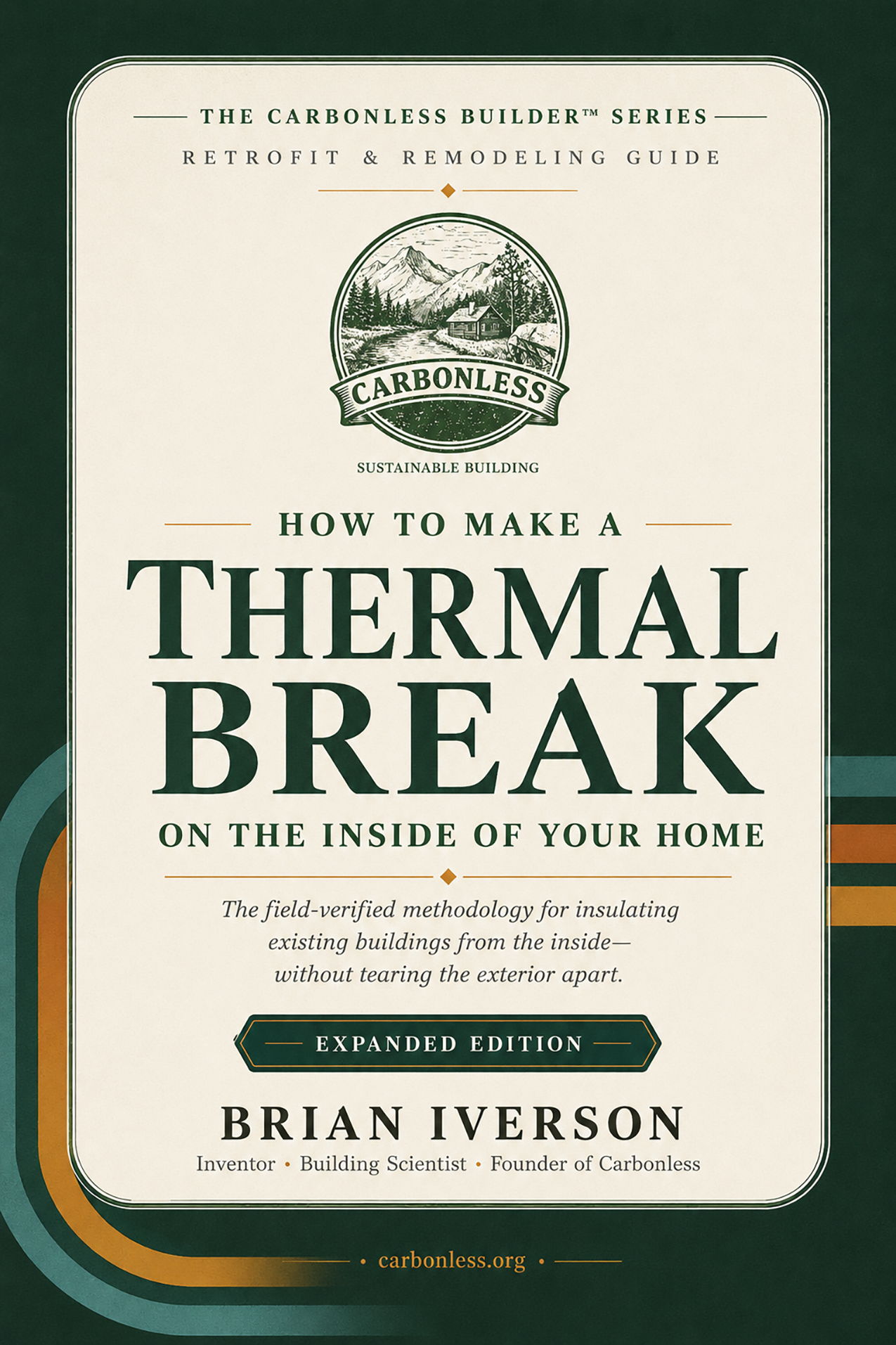
Inside the Book
How to Make a Thermal Break on the Inside of Your Home
279 pages · 30 chapters · 88 building assemblies · 51 years of building
This is the field-verified method for making any existing home dramatically more efficient — from the inside, without tearing the exterior apart. It is the same building science most people pay thousands of dollars in consulting to learn, written down in plain language and backed by 88 worked assemblies you can pull and use on a real wall, a real roof, in a real climate.
The 30 Chapters
The book moves the way a building scientist actually thinks: understand the problem, fix it from the inside, prove it with numbers, then build a business around it.
1. Why Did You Buy This Ebook?
2. What You Will Find in This Book
3. How Your House Actually Works
4. The House Is Talking to You
5. The Walk-In Cooler Nobody Told You About
6. The Submarine
7. A Brand New House That Will Fail
8. The Code Is the Floor, Not the Ceiling
9. Always Start at the Bottom
10. The Dew Point: A Survival Guide
11. The Interior Thermal Break: The Strip Method
12. The Affordable Perfect Wall
13. The Ceiling Is the Killer
14. Insulation: Replacing Fiberglass With Something That Actually Works
15. Closed Cell Spray Foam: The Three-Inch Minimum Rule
16. Windows: The Affordable Upgrade Nobody Talks About
17. Mold: The New Asbestos
18. Vapor Barriers: Why Paint Peels
19. Ventilation: ERVs, HRVs, and Why the Bath Fan Is Not Enough
20. Stopping Moisture at the Source
21. What Your 2×4 Wall Actually Performs At
22. What Your 2×6 Wall Actually Performs At
23. Manual J: The Calculation Nobody Does
24. The Retrofit Business Blueprint
25. What I Refuse to Teach
26. Affordable Housing and Why I Invented the Carbonless Builder Panel System
27. The Carbonless Builder Brand: For Everyone Who Touches Buildings
28. Designing Your New Home: Room Placement, Views, Scenery, and Why Feng Shui Got It Right
29. Why I Am Not Your Mold Inspector
30. The Future of Housing: HOPE
Plus an epilogue, the full assembly-table appendix, and a complete plain-language glossary of every technical term used in the book.
Your utility bill is not going back down.
In the last five years the price of residential electricity in America climbed about 21 percent. In 2025 it rose faster than inflation — faster than groceries, faster than gas, faster than medicine. One in six households is already behind on their energy bills. Hundreds of utilities have rate increases approved or pending through 2027. Nobody is forecasting relief.
Now run that forward thirty years.
The house you own — or the one your kids hope to own someday — is going to cost more to heat and cool every year for the rest of its life. Not because of how you live in it. Because of how it was built. A building built to code is built to the floor — the legal minimum — and then the family inside it pays the difference between the floor and what the building should have been, every single month, forever.
That is the math nobody wants to look at. A whole generation priced out of affording the buildings they already live in. Kids who cannot afford the land to build on because the utility bill on the house eats the down payment.
Here is the part nobody is telling you: you can break that curve from the inside.
You do not have to tear the house apart. You do not have to rebuild the exterior. A thermal break on the inside of your existing walls can cut what that building costs to operate — permanently, for the rest of its life. This eBook is the only place that method is written down in plain language.
That is why this exists. Not to add a book to a shelf. To put the way out in the hands of the people who need it, before the thirty-year bill comes due.

Here’s what almost nobody understands about an existing wall.
At just a half-inch of interior strip depth — the thinnest application there is — a typical wall gets a continuous thermal break from the inside. Even with one of the most affordable fills there is, blown-in cellulose, that half inch lifts the whole-wall effectiveness by more than 25 percent over the bare existing wall.
A half inch. The most affordable fill. Over 25 percent better.
Now imagine what the best assemblies in this eBook do at two inches — over 138 percent more efficient than the wall you have today. Picture that number dropping into a Manual J load calculation: a smaller heating and cooling load, smaller equipment, a lower utility bill every month for the life of the building.
Most people have never heard of a Manual J. That is exactly the problem. This eBook shows you the number, what it means, and how to use it — for every common wall assembly, at every strip thickness, with the verified math behind it.