
Carbonless 2126 Education
Forty courses. Sixteen perspectives. One hundred years of consequences.
The decisions we make about buildings today belong to the people who will live with them tomorrow.
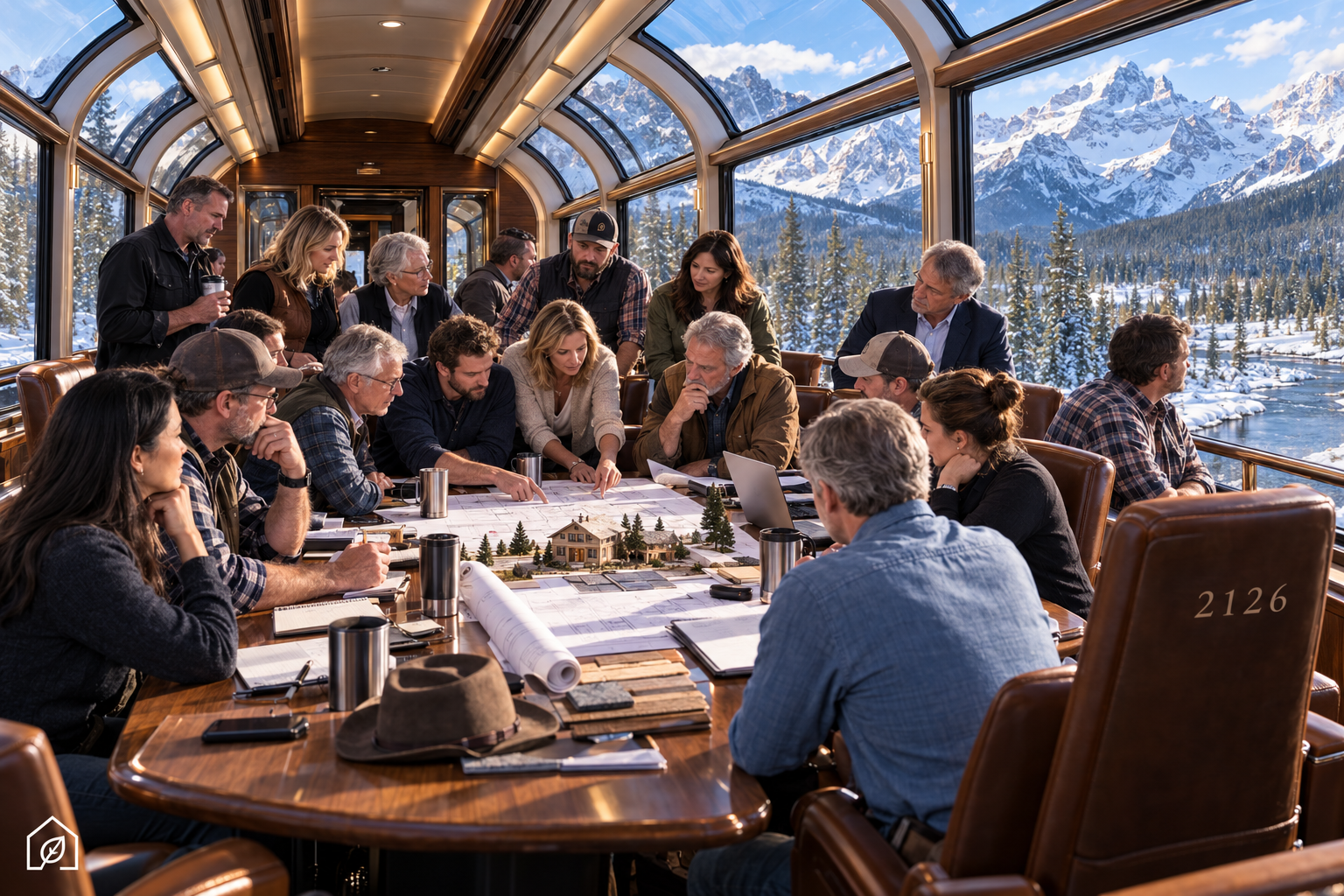
Sixteen people are riding this train, and one of them hasn’t been born yet. Course 00 is free. Start there, then take the other courses in any order you like.
Everybody Needs to Be on the Same Train
Imagine sixteen people sitting in the front glass dome of the Rocky Mountaineer.
Everybody’s looking out the same window. Everybody’s heading toward the same destination.
But they’re all looking at different things.
The developer sees the land. The banker sees the loan. The architect sees the design. The builder sees the construction. The inspector sees whether the work meets the requirements.
And the person who’s going to live there? They’re thinking about whether the place will be healthy, comfortable, and affordable.
Then there’s somebody else riding with us.
The person from 2126.
That person may not even be born yet. But they’re going to inherit the decisions we make today.
And that’s why everybody needs to be on the same train.
Nobody on this train is above anybody else. Every perspective matters. The destination is a building worth inheriting.
What Does Everybody Want From a Building?
I don’t care whether you’re the buyer, the owner, the tenant, the employee, the person designing it, or somebody who inherits it 100 years from now.
There are certain things every building ought to deliver.
And after 52 years in this industry, I’m tired of seeing people pay for problems that should have been prevented.
1. No mold, mildew, or rot.
Nobody wants mold growing behind their walls, mildew spreading through their home, or structural members rotting because somebody got the moisture wrong. We teach how water, humidity, air movement, temperature, and drying affect buildings, and how to prevent recurring moisture problems.
2. An unbelievably healthy place to live and work.
Clean indoor air. Proper ventilation. Filtration. Controlled humidity. Reduced exposure to pollutants. Buildings should protect the people inside them, not create unnecessary health risks.
3. Affordable living for generations.
It’s not enough to afford the mortgage or rent. You have to afford the electricity, water, maintenance, taxes, insurance, and repairs. If your grandchildren inherit the house, can they afford to keep it?
4. Comfort in every room, every season.
No freezing bedrooms, overheating, miserable humidity, drafts, or rooms that never reach a comfortable temperature.
5. Super energy efficiency.
Thou shalt not waste electricity. We teach people how to reduce heating and cooling loads before selecting expensive equipment.
6. Water conservation.
Thou shalt not waste water. Every unnecessary gallon going down the drain is a design decision somebody made.
7. Long-term durability.
Buildings should be designed for a long service life, with proper maintenance, rather than becoming expensive repair projects after a few years.
8. Safety and resilience.
A building should protect people through storms, power interruptions, extreme temperatures, fire risks, and foreseeable emergencies.
9. Easy maintenance, repair, and adaptation.
Equipment needs to be accessible. Assemblies need to be understandable. Future owners should know how the building was constructed and how to maintain it.
10. Something worth passing on.
The next generation should inherit a healthy, useful, affordable building, not hidden mold, failed roofs, enormous utility bills, and somebody else’s mistakes.
These are goals we teach people to work toward, not guarantees that every building will achieve all ten.
Sixteen People. Sixteen Perspectives. Everybody Has a Seat.
Every one of these people touches a building, and every one of them lives with what the others decided. Carbonless 2126 talks to all sixteen, in plain English, about their part of the work.
01 — The Landowner
The person who controls the land and wants it to remain valuable and useful. We teach how the decisions made before development can affect a property for generations.
02 — The Civil Engineer / Site Steward
The person responsible for understanding drainage, grading, water movement, soils, infrastructure, and how the building fits the site.
03 — The Developer
The person turning land into places where people will live and work. We teach why development decisions need to consider lifetime ownership costs, infrastructure, durability, and the future community.
04 — The Mortgage Banker / Lender
The person financing the investment. We teach why utility costs, building performance, maintenance burdens, and long-term affordability matter to the financial picture.
05 — The Insurance Agent
The person evaluating risks and helping owners understand coverage. We teach how moisture, construction failures, exposure, and resilience affect the building and its occupants.
06 — The Realtor
The person helping someone buy or sell a building. We teach why buyers should understand more than appearance, square footage, and the asking price.
07 — The Attorney
The person dealing with contracts, responsibilities, disclosures, warranties, and disputes. We teach the building-science principles behind many of the decisions and disagreements that arise.
08 — The Architect
The person designing the building and integrating the enclosure, layout, materials, occupant needs, and performance goals.
09 — The Draftsperson / Designer
The person turning ideas into drawings and construction details. We teach why every connection, penetration, transition, and assembly needs to be represented clearly.
10 — The Builder
The person putting it all together. We teach how to build a tight, efficient, durable enclosure and coordinate the people doing the actual work.
11 — The Building Performance Professional
The person measuring and evaluating how the building really performs. We teach air leakage, insulation performance, thermal bridging, ventilation, moisture, testing, and the importance of actual numbers.
12 — The Building Inspector / Authority
The person checking compliance and construction requirements. We teach the difference between meeting minimum code requirements and understanding the building’s long-term performance.
13 — The Remodeler
The person who inherits yesterday’s construction decisions and has to figure out how to fix or improve them without creating new problems.
14 — The Owner
The person paying the bills, maintaining the investment, making repair decisions, and trying to preserve the building’s value and usefulness.
15 — The Occupant / Tenant / Employee
The person living or working inside the building. They experience the air quality, mold, comfort, moisture, utility costs, noise, safety, and everyday consequences of what everybody else decided.
16 — The Person From 2126
The person who inherits everything and decided none of it.
They may be your grandchild, great-grandchild, a future homeowner, a tenant, or somebody working in that building a century from now.
They’re the reason we need to think beyond the day construction is finished.
From the Dirt Beneath the Building to the Person Living There in 2126.
We start with the land.
Before somebody draws the house. Before somebody pours the concrete. Before anybody orders a furnace or installs a window.
Because the mistakes can start before construction ever begins.
And then we follow the decisions that shape the building: site planning, foundations, walls, roofs, insulation, thermal breaks, windows, air sealing, ventilation, HVAC, moisture, water, construction quality, operation, maintenance, remodeling, and what happens decades later.
We don’t teach this from one perfect building.
We teach it from real houses, real projects, real investigations, and the mistakes and lessons that come with them.
All sixteen people need to understand how their decisions affect everybody else.
Forty courses, Course 00 through Course 39, grouped into eight bundles. A beaver doesn’t build a dam with one stick, and nobody learns a whole building from one course. Each course stands on its own. There are no mandatory prerequisites, so you can take them in any order you choose, one at a time or all forty.
The full program: Carbonless 2126
Most building education starts at the house. Carbonless 2126 starts at the dirt. It covers the land, the money, the structure, the walls and roof, heat and moisture, the systems, the people inside, the equipment, and handing the building down to the person who lives there in 2126.
Why people take it. Most of what a house costs over its life is decided before anybody digs a hole. A wet wall, a moldy roof or a furnace sized wrong can cost more than this whole program. I have spent 52 years walking houses and buildings, and I have paid for plenty of those mistakes myself. My own house runs about $60 a month. This program is so you can get there without paying for the mistakes first.
Who it is for. Everybody who touches a building: landowners, developers, builders, remodelers, designers, HVAC and insulation contractors, inspectors, Realtors, lenders, insurance people, owners and renters. Every course speaks to all 16 people at the table, because a mistake in one seat ends up in somebody else’s lap.
Why schools use it as a full curriculum. It is 40 courses and more than 78 hours, built to stand on their own or to run as one complete program, from the land all the way to the next generation. Every course has a 20-question test and a Record of Completion. Schools and training centers can offer one course or all 40.
Used around the world. Heat, air and water move the same way in every country. People reach out from all over North America and beyond, and I have done consulting jobs as far away as Greenland and France.
What you get. Forty courses, each two hours or more. A Record of Completion for every course you pass with 80% or better. Real photos from real jobs, new construction and repairs, with more added all the time. The complete program is $3,900, or take one course at a time for $100. It is included in Carbonless Membership.
What it is not. It is not a license, a certification or accredited credit. Some boards let you self-report it. Ask yours.
What it costs
The first course is free.
$100 per course.
$400 to $500 per bundle of courses.
$3,900 for the complete program.
You do not have to buy it all. Every course and every bundle has its own description, so you can pick the ones that fit your work. Members get the entire program.
The eight bundles
Bundle 1 · Land + Site
Courses 1–5 · $500
Before anybody draws the house.
Bundle 2 · Structure + Foundation
Courses 6–10 · $500
The bones of the building.
Bundle 3 · The Building Envelope
Courses 11–15 · $500
The line between inside and outside.
Bundle 4 · Heat + Moisture
Courses 16–20 · $500
Why buildings rot, grow mold and waste energy.
Bundle 5 · Water + Building Systems
Courses 21–25 · $500
The systems that keep a building working.
Bundle 6 · People + Indoor Environment
Courses 26–30 · $500
The people inside and around the building.
Bundle 7 · Mechanical + Controls
Courses 31–35 · $500
Built to last a century and sized right.
Bundle 8 · Proof + Living + Legacy
Courses 36–39 · $400
Closing the loop.
Continuing education
$50 per hour of continuing-education instruction
This is for educational instruction purchased on its own, separate from our existing products. It does not apply to education already included with a product, with Carbonless 2126 or with Carbonless Membership.
Carbonless 2126 pricing stays the same: The first course is free, individual courses are $100 each, and the complete 40-course program is $3,900.
What a Record of Completion means
Pass a Carbonless 2126 course test with 80% or better and you get a Record of Completion. It is a record of education. It is not a license, a professional certification or accredited credit.
Carbonless does not offer professional certification or automatically approved continuing-education credits. Some licensing boards and associations let you self-report education. Whether an hour counts toward your continuing-education requirement depends on your licensing board, and on what Carbonless and its educational partners are authorized to provide. Ask before you count on it for a license.
Teach it or host it
Carbonless 2126 is a complete curriculum, ready to teach. We’re looking for universities, technical colleges, higher-education centers, and professional organizations that want to host it or teach it, one course or all forty.
If you teach a class, train a crew, or run a program, write to us at hello@carbonless.org and tell us what you teach.